
'If you look at the entire 60-day period of March and April, you see that temperatures were soaring more than 3.5 degrees Celsius above the maximum temperature.' 'Normally, events like this happen only for a short period.'

Western disturbances are near Pakistan-Afghanistan and are moving towards Delhi and thunderstorms or dust storms are likely to be experienced in northwest India, senior scientist at IMD RK Jenamani told ANI.

The Mungeshpur weather station recorded a high of 48.8 degrees Celsius, eight notches above the normal. It recorded a minimum temperature of 27.6 degrees Celsius, a notch above the season's average.

Seven out of eight women street vendors reported experiencing high blood pressure, while women in the middle age group raised concerns about delays in their menstrual cycles due to the extreme heat.
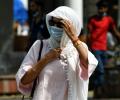
No part of northwest, central and east India is likely to record a heatwave over the next five days, the MeT office said.

The searing heat pushed the city's peak power demand to its highest for May, while the Delhi government directed the schools that have not closed for summer vacations to do so with immediate effect.
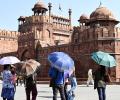
'The intensity and frequency of heatwaves will be much higher than in previous years over Punjab, Haryana, Rajasthan, Gujarat, Madhya Pradesh and Odisha.'

IMD data shows in the 24 hours between September 1 and 2, Haryana received 806 per cent more rainfall than normal, Punjab 759 per cent, Himachal Pradesh 510 per cent, Delhi 740 per cent, Chandigarh a staggering 1,638 per cent, and Rajasthan 193 per cent.

The mercury breached the 46-degree Celsius mark in several places such as Allahabad (46.8 degrees Celsius) and Jhansi (46.2 degrees Celsius) in Uttar Pradesh; Sports Complex (46.4 degrees Celsius) in Delhi; Ganganagar (46.4 degrees Celsius) in Rajasthan; Nowgong (46.2 degrees Celsius) in Madhya Pradesh; and Maharashtra's Chandrapur (46.4 degrees Celsius).

Mother Dairy has hiked milk prices by up to Rs 2 per litre effective Wednesday to partly offset rising input costs. The price revision will be effective from April 30, 2025 across its market, a company official said on Tuesday.

Delhi Water Minister Atishi on Friday began her indefinite hunger strike in south Delhi's Bhogal to press on her demand for more water from Haryana.

A fresh spell of heatwave is likely to begin over northwest India from May 7 and over central India from May 8, the India meteorological department said on Thursday.

East and northeast India recorded 29 per cent rain deficit -- 141.5 mm against the normal of 199.9 mm -- from March 1 to May 3.

Severe heatwaves, responsible for thousands of deaths across India over the last few decades, are increasing with alarming frequency and soon the country could become one of the first places in the world to experience heatwaves that break the human survivability limit, according to a new report.

Lightning claims more lives in India annually than any other extreme weather event. Between April and July this year alone, 1,621 people died due to lightning strikes.

The IMD said heatwave conditions are likely to continue over the northern plains, and central and southern parts of the country for two more days and abate gradually.

A study shows that the country has experienced 706 heatwave incidents from 1971-2019.

The weather department also said the national capital recorded only two rainy days this May, the lowest in 10 years.

' Number of school hours per day may be reduced. Sports and other outdoor activities which expose students directly to the sunlight may be appropriately adjusted in the early morning'

>Bihar (18 days) has the most number of heatwave days in 2023, followed by Andhra Pradesh (15 days), Odisha (15 days), Jharkhand (13 days), West Bengal (8 days) and Tamil Nadu (6 days).

The mercury soared to 46.2 degrees Celsius at Najafgarh, making it the hottest place in the capital.

According to an IMD forecast issued on Thursday, a heatwave spell will persist over northwest and central India during the next five days and over east India during the next three days.

It said Delhi is facing an unprecedented heatwave with temperatures hovering around 50 degrees Celsius in some parts for the first time in the city's history.

Mercury hovered around 40 degrees Celsius in large parts of the country on Monday as the Indian meteorological department predicted heat wave conditions in parts of east India over the next four days and the northwest region over the next two days.

The India Meteorological Department (IMD) has predicted above-normal rainfall for the upcoming monsoon season in India (June to September). The cumulative rainfall is estimated to be 105 percent of the long-period average. The IMD has also ruled out the possibility of El Nino conditions during the entire season. The monsoon is crucial for India's agriculture sector, which supports the livelihood of a significant portion of the population and contributes substantially to the country's GDP. However, while the prediction of normal rainfall brings relief, climate change is expected to cause variations in rainfall distribution.

Delhi's peak power demand reached an all-time high of 8,302 MW on Wednesday afternoon as the city logged its highest-ever temperature of 52.3 degrees Celsius at the Mungeshpur weather station.
India experienced its second-hottest quarter from June to August this year since 1970, with over one-third of the country's population enduring at least seven days of dangerous heat, according to a new report by a United States-based group of climate scientists and communicators.

The Met office has issued a "red" warning for Delhi, Haryana, Punjab and west Rajasthan, stressing the need for "extreme care for vulnerable people".

Temperatures in 17 locations breached 48 degrees Celsius on Monday, with the relentless heat affecting health and livelihoods across large parts of northwestern and central India.

Power distribution company officials said several areas, largely in central and east Delhi, were affected due to the failure. Some areas in north Delhi also faced outages.

The India Meteorological Department, which had issued a red colour-coded alert for north India for May 25-26 when the prevailing heatwave conditions are expected to peak, said dust and thunderstorms are likely to bring some relief on May 29-30.

More than 80 per cent of Indians live in districts vulnerable to climate risks. Among these, Assam, Andhra Pradesh, Maharashtra, Karnataka, and Bihar are the most vulnerable states to extreme climate events.

The year 2024 was the hottest year on record, with the global average temperature exceeding 1.5 degrees Celsius above pre-industrial levels for the first time, according to the European climate agency Copernicus. Every month from January to June was the warmest ever recorded, and from July to December (except August), each month was the second warmest on record. Scientists are warning that the world is entering a new climate reality, with extreme heatwaves, floods, and storms becoming more frequent and severe. The report also highlights the failure of developed nations to meet their climate finance commitments to developing countries, despite the urgency of the situation.

The India meteorological department said another western disturbance is likely to bring storms and rain to the northern plains, including Delhi, over the next few days.

Delhi recorded its second hottest April this year since 1951 with a monthly average maximum temperature of 40.2 degrees Celsius.

The maximum temperature at the Safdarjung Observatory, Delhi's base station, rose to 42.5 degrees Celsius.

Parts of south, east and northeast India are expected to get some relief from the blistering heat, with the onset of monsoon expected to take place over Kerala on Saturday.

A tormenting heatwave swept through North India on Sunday with the mercury crossing 49 degrees Celsius in pockets of Delhi, while the weather office forecast some relief Monday onwards.

Government sources said Modi will also chair meetings to review the aftermath of the Cyclone Remal, especially in the north east region hit by natural disasters.

The Safdarjung Observatory, which provides representative data for the city, recorded a maximum temperature of 40.1 degrees Celsius, which was eight notches more than normal, said Kuldeep Srivastava, the head of the IMD's regional forecasting centre.
